Webinar: Accelerating Biomarker Discovery through Large-Scale Motion Capture Using OpenCap
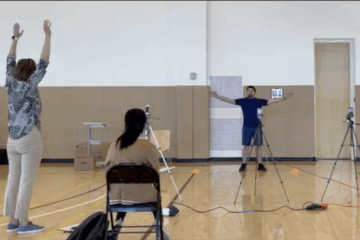
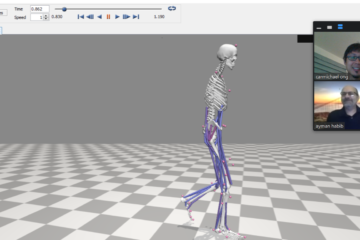
In this two-part webinar, Mr. Ruth will share his team’s process and best practices gained from the past three years of large-scale OpenCap data collection.
Current clinical scores for predicting patellar instability treatment outcomes rely on 2D imaging measurements that do not fully describe 3D anatomy. Marissa Sinopoli and a team of Mobilize Center researchers at Stanford University developed a novel 3D medical imaging-based anatomical score for Read more
Details This event has passed. View the recorded talk and additional resources below. Abstract Designing optimal orthopedic surgery, physical rehabilitation, and neurorehabilitation interventions using “digital twins” of individual patients is an important goal of neuromusculoskeletal modeling. The open-source Matlab-based Neuromusculoskeletal Modeling (NMSM) Read more
We are now accepting applications for a three-day, project-based OpenSim+ workshop on the Stanford University campus. This workshop will take place March 24-26, 2026 and is intended for researchers who are advanced users of our software tools, models, and datasets, Read more
In this webinar, Dr. Lee and Dr. Clouthier will demonstrate how incorporating joint geometry into musculoskeletal models can reveal why certain bone shapes increase injury risk. They will also lead an interactive tutorial on using statistical shape models to map soft tissue attachment sites across bone shapes for musculoskeletal simulation.
Neuromuscular disorders are often assessed with timed function tests (TFTs), which are quick to administer in the clinic but do not adequately capture disease-specific movement patterns. Parker Ruth and colleagues at Stanford used OpenCap to capture movement across two neuromuscular Read more
Knee osteoarthritis is a degenerative joint condition often treated with surgery or medication. A new, year-long randomized controlled trial investigated whether a non-invasive, non-pharmacological approach could decrease pain and slow the cartilage damage typically observed in osteoarthritis. In the trial, Read more
In this webinar, Dr. Cotton will discuss his lab’s recent advances in markerless motion capture that address these needs using both single-camera and multiview video approaches. He will also lead an interactive tutorial on fitting biomechanics from a sample monocular video using his algorithms.
We are pleased to announce we will be holding Virtual Office Hours to support researchers working with wearable sensors, video technology, and other modalities in rehabilitation research. These office hours are offered as part of the training efforts of our Read more
According to the CDC, over 39 million people in the US live with physical impairments, challenging their independence. Sustained efforts in the research community and industry have led to hardware and software solutions for improving mobility. However, widespread adoption of Read more